Learn words on your lock screen
Glancewords is an Android app that shows a word each time you turn on the screen, and brings it back just before you would forget it.
Get it on Google Play The first 100 words of every course are free
Tuesday, 3 November
Try it: tap the card, then say whether you knew the word.
False friendIk wil means "I want", not "I will". For the future use zullen or gaan: Ik ga morgen werken.
A1 · Beginner
willen (wilde, gewild)
Tap to reveal
to want; to want to, be willing to; would like
Wil je dat ik langskom? (Do you want me to come by?)
A few seconds at a time
You turn on your phone's screen dozens of times a day. Each time, a word is waiting.
The screen turns on
The card is over the lock screen, under the clock. Swipe up and your phone unlocks as usual, with your fingerprint or PIN.
Tap for the meaning
You see the translation, an example sentence and, on many words, a note about the trap in it: a false friend, a look-alike, an irregular form. The speaker button reads the word aloud.
Say whether you knew it
Again brings the word back in 10 minutes. Got it sends it away for three days, then longer each time: weeks, then months. Words you find hard come back sooner. The schedule comes from FSRS, the algorithm modern Anki uses.
Then it leaves you alone
A word never returns before it's due, and when nothing is due, your lock screen is yours again. You can also pause the card for an hour or until morning.
Notes on the traps
Many words carry a short note, written for the mistakes speakers of your language really make. Four from the Dutch course:
willen
False friendIk wil means "I want", not "I will". For the future use zullen or gaan: Ik ga morgen werken.
de familie
False friendUsually means your relatives, the wider family. Parents and their children together are het gezin.
lopen
Similar wordsLopen usually means to walk; to run is rennen: Ik loop naar school, maar ik ren naar de bus. Hardlopen is running as a sport.
kijken
UsageLooking at something usually takes naar: Ik kijk naar de foto. Tv kijken (to watch TV) is a common exception.
If you also know Russian, tick it on the first screen: 31 Dutch words then get a second note in Russian, where Russian explains them better.
Three ways to see a word
-
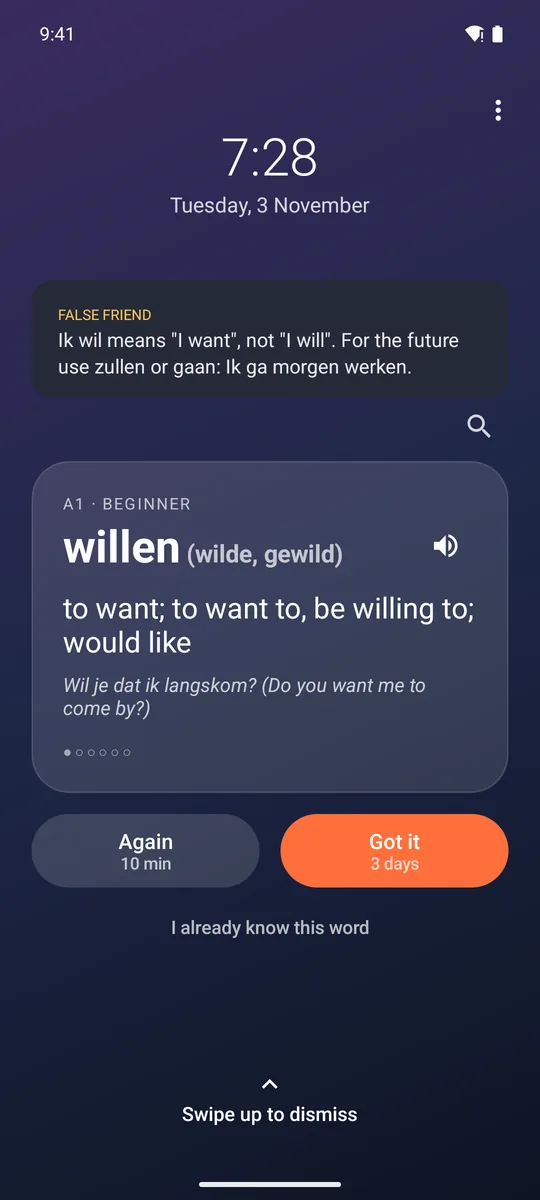
Full-screen card
Over the lock screen until you swipe up, with an example and pronunciation.
-
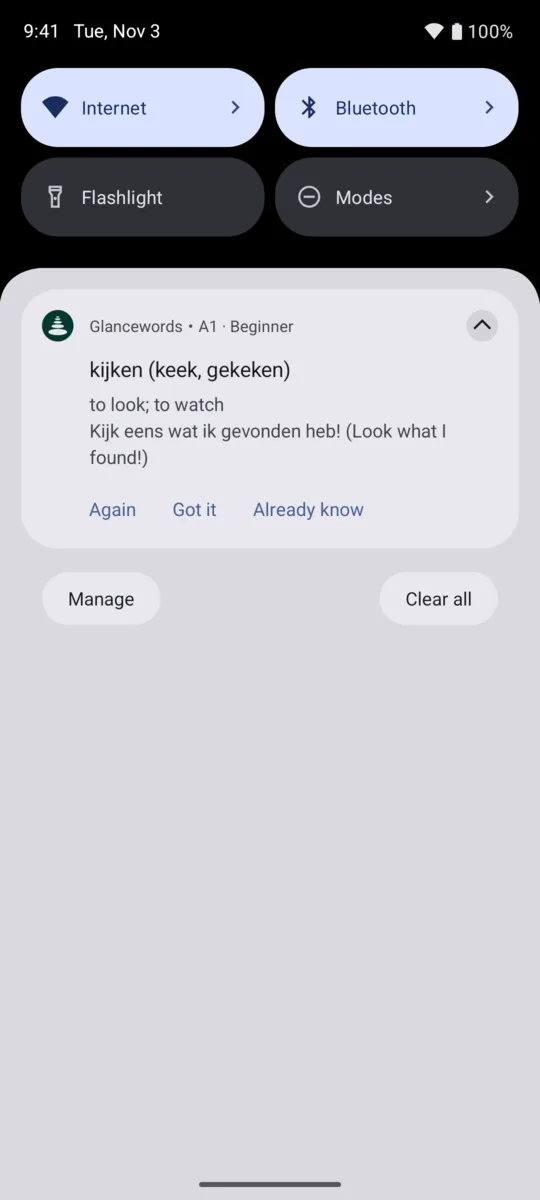
Notification
Sits with your other notifications. Answer it without unlocking.
-
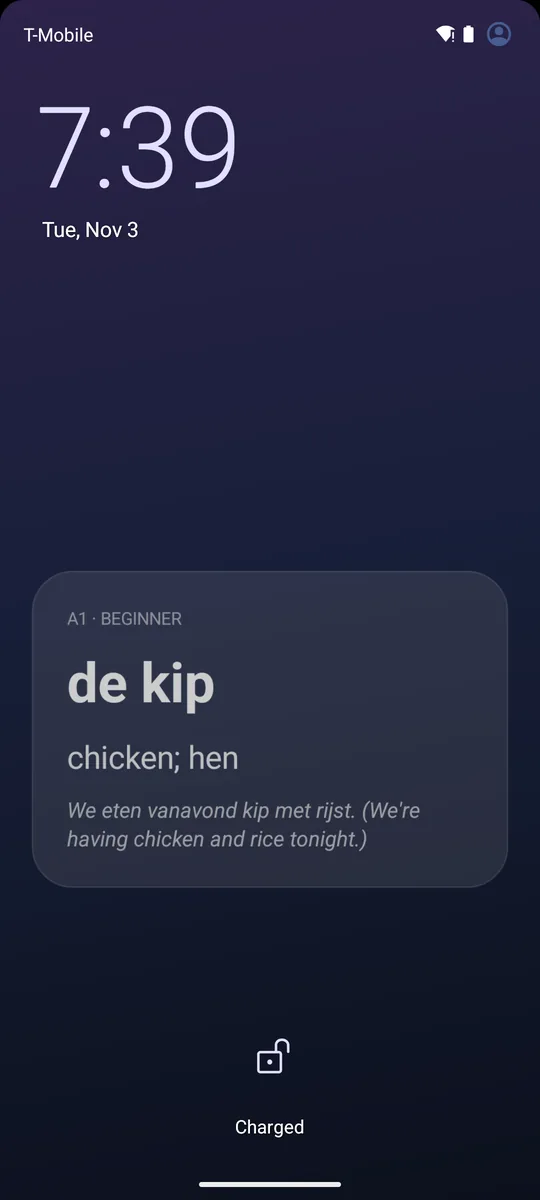
Wallpaper
The word, its meaning and an example on your lock-screen picture. Nothing to tap, no permissions.
There's also a home-screen widget.
Courses
English levels follow the CEFR. The Dutch levels are approximate.
Dutch for English speakers
- A1 · Beginner
- 450
- A2 · Elementary
- 500
- B1 · Intermediate
- 396
1,346 words with example sentences. 31 of them also have a note in Russian.
Inglés para hispanohablantes
English for Spanish speakers
- A1 · Inicial
- 1,020
- A2 · Básico
- 432
- B1 · Intermedio
- 419
- B2 · Intermedio alto
- 397
- C1 · Avanzado
- 299
- Verbos frasales y expresiones
- 226
2,793 cards, with notes on Spanish false friends. 20 also have a note in Russian.
Английский для русскоговорящих
English for Russian speakers
- A1 · Начальный
- 1,033
- A2 · Элементарный
- 399
- B1 · Средний
- 386
- B2 · Выше среднего
- 387
- C1 · Продвинутый
- 298
- Фразовые глаголы и выражения
- 226
2,729 cards, with notes on Russian false friends. 148 also have a note in Spanish.
Your own words: import a list (CSV, TSV or TXT) or an Anki deck (.apkg) in any language.
What it costs
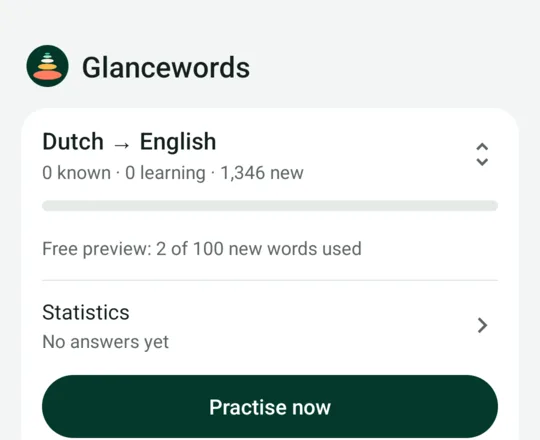
The first 100 words of every courseFree
Every feature, no time limit.
The rest of a courseOne purchase
Paid once through Google Play, no subscription. Words you've started stay yours either way.
Your own lists and Anki decksFree
As many as you like, with the same card and schedule.
AdsNone
Not in the free words, not anywhere.
No account, no ads, no tracking
Your words and progress stay on your phone, and learning works offline. The app's own code sends nothing anywhere; only Google Play's billing goes online, to check which courses you own.
- The word lists, including the ones you import
- Your answers and progress on each word
- Your settings
All of it lives in the app's own storage. A backup file you make yourself takes the word lists and your progress to a new phone; settings stay with the phone. Read the privacy policy
Questions
Which phones does it work on?
Android 10 and newer. There is no iPhone version.
Does it need the internet?
No. Learning works offline. When you open the app, Google Play is asked which courses you own and what they cost, and buying one goes through Play.
Will it get in the way when I need my phone?
One swipe up and you're at your usual lock screen. The card stays off calls and alarms, and you can pause it, or switch to the quieter notification.
Can I learn my own words?
Yes. Import a word list or an Anki deck, in any language, and the words get the same card and the same schedule. Imports are always free.
What happens when I change phones?
Back up your words and progress to a file and restore it on the new phone. Purchases come back with your Google account.
How long does it take?
A few seconds a word: look, tap for the meaning if you need it, and answer.